
Rubizh Brigade: From Hostomel to Ukraine’s Modern National Guard
 By admin
oktober 28, 2026
The Rubizh Brigade (Ukrainian: Бригада «Рубіж») is the 4th Operational Assignment Brigade of the National Guard of Ukraine. Established in 2015, it was among Ukraine’s early attempts to create a modern, professional rapid-response military formation based on NATO-inspired organisational and training standards.
The brigade’s history predates Russia’s full-scale invasion of 2022. Its personnel fought in eastern Ukraine during the earlier stages of the Russo-Ukrainian War before participating in the defence of Hostomel Airport, the battles for Sievierodonetsk and Rubizhne, and subsequent operations around Bakhmut and in the Donetsk region. In 2023, the formation became part of Ukraine’s Offensive Guard initiative and adopted the name Rubizh, meaning approximately frontier, boundary or line of defence.
Since 2025, the brigade has belonged to the 2nd Khartia Corps of the Ukrainian National Guard, although it has also operated alongside the 1st Azov Corps.
General Information
| Category | Information |
|---|---|
| Official name | 4th Operational Assignment Brigade |
| Common English name | Rubizh Brigade / 4th Rapid Response Brigade |
| Ukrainian name | 4-та бригада оперативного призначення «Рубіж» |
| Honourary designation | Named after Hero of Ukraine Sergeant Serhiy Mykhalchuk |
| Formation | 2015 |
| Military unit number | 3018 |
| Country | Ukraine |
| Military branch | National Guard of Ukraine |
| Parent formation | 2nd Khartia Corps |
| Current commander | Colonel Mykyta Plikhun |
| Callsign | Roger |
| Historical garrison | Hostomel, Kyiv Oblast |
| Military role | Rapid response, operational defence and assault operations |
| Motto | We Are Reclaiming the Country’s Rightful Borders |
The names, official designation and command information are supported by the brigade’s recruitment profile and Ukrainian military sources.
Current Military Leadership

Colonel Mykyta Plikhun
Brigade Commander · Callsign “Roger”
Plikhun graduated from the National Guard Academy in Kharkiv and progressed through several command positions before taking command of Rubizh. His military experience includes the Svitlodarsk sector and the battles for Rubizhne, Sievierodonetsk, Lysychansk and Bakhmut. He was identified as acting commander in November 2025 and is listed as the brigade’s commander in 2026.
Dmytro Bukhalo commanded Rubizh during an earlier period of its development and the full-scale war. He was succeeded by Serhii Sidorin in January 2025. Sidorin, a veteran of fighting in eastern Ukraine since 2014, led the formation during part of 2025. By late 2025, Plikhun was performing the commander’s duties and subsequently became its commander.
Origins and Development
Establishment of the 4th Rapid Response Brigade (2015)
Rubizh’s origins date to 2015, when Ukraine was restructuring its military and security forces following Russia’s intervention in Crimea and eastern Ukraine. The National Guard sought to develop a professional rapid-response formation capable of responding to military threats across the country. The brigade was established with an emphasis on longer-term contracts, professional training and modern military standards. Its original identity was the 4th Operational Assignment Brigade.
Service in Eastern Ukraine (2016–2020)
The brigade received its military colours on 2 June 2016. Its personnel served around Stanytsia Luhanska, Mariupol and the Svitlodarsk salient, where Ukrainian formations confronted Russian-backed armed groups. From September 2019 to May 2020, the brigade participated in frontline operations around Svitlodarsk. In August 2020, the unit was officially named in honour of Sergeant Serhiy Mykhalchuk, who had been killed in combat in December 2019.
The Full-Scale Russian Invasion (2022)
On 24 February 2022, members of the brigade were among the Ukrainian defenders confronting Russian airborne forces during the assault on Hostomel Airport. After the defence of the Kyiv region, brigade personnel were engaged in heavy fighting in Luhansk Oblast, including Rubizhne, Popasna, Sievierodonetsk and Lysychansk. The formation subsequently participated in the Ukrainian counteroffensive in the Kharkiv region and operations around Lyman.
The Offensive Guard and the Rubizh Identity (2023)
In early 2023, Ukraine launched the Offensive Guard recruitment initiative, expanding several National Guard and Interior Ministry formations. The 4th Brigade joined the initiative under the name Rubizh. By this period, the brigade was also participating in fighting around Bakhmut, where Russian and Ukrainian forces were engaged in prolonged combat.
Continued Frontline Operations (2024)
During 2024, Rubizh personnel operated in several eastern and northeastern sectors. The brigade’s published history identifies operations near Hlyboke and Lyptsi in the Kharkiv region during the summer and autumn. The importance of drones, reconnaissance, engineering and combined-arms support continued to increase.
Integration into the Corps System (2025–2026)
In April 2025, Ukraine announced the formation of the 2nd Khartia Corps of the National Guard, with Rubizh among its constituent brigades. From the second half of 2025, Rubizh was also involved in defensive operations around Pokrovsk and Dobropillia, working alongside elements of the 1st Azov Corps. In October 2026, the brigade continued to feature in official Ukrainian reporting concerning the defence of the Dobropillia sector.
Major Military Operations
The Battle of Hostomel (February 2022)

The defence of Hostomel was one of the most consequential events in Rubizh’s history.
On 24 February 2022, Russian airborne forces launched an assault on Antonov Airport northwest of Kyiv. The operation was part of Russia’s attempt to establish a foothold near the Ukrainian capital. Rubizh personnel were among the Ukrainian defenders confronting the attack, alongside other Ukrainian military and security formations. Ukrainian government accounts credit the defenders with disrupting the initial airborne operation and preventing Russia from quickly establishing the airbridge it had sought. The battle became an important early episode in Ukraine’s defence of Kyiv. Rubizh’s participation remains central to the brigade’s military identity.
Rubizhne and Sievierodonetsk (2022)
Following the battles around Kyiv, Rubizh personnel were involved in operations in Luhansk Oblast. The region became the scene of intense Russian offensives during the spring and summer of 2022. The brigade’s published combat history identifies engagements around Rubizhne, Popasna, Sievierodonetsk and Lysychansk. The fighting involved urban warfare, sustained artillery bombardment and repeated Russian attempts to break through Ukrainian defensive positions.
Rubizh took part in the broader Ukrainian defence of the region, which eventually saw Russian forces capture several important cities during the summer of 2022.
Kharkiv Counteroffensive and Lyman (2022)
Rubizh personnel also participated in the Ukrainian counteroffensive that began in the Kharkiv region in September 2022. The operation resulted in the liberation of significant territory and the withdrawal of Russian forces from several occupied settlements. The brigade subsequently participated in operations connected to the liberation of Lyman. These operations marked an important transition from the defensive battles of the invasion’s early months to offensive operations intended to restore Ukrainian control over occupied territory.
Bakhmut (2022–2023)

From late 2022, Rubizh participated in fighting in the Bakhmut sector. The battle became one of the longest and most destructive engagements of the full-scale war. Ukrainian forces faced sustained Russian attacks, heavy artillery fire and intense pressure on their defensive positions. Rubizh was among numerous formations deployed in this sector. Its involvement in the fighting became another major part of the brigade’s wartime experience.
Pokrovsk and Dobropillia (2025–2026)
The Pokrovsk and Dobropillia sectors became particularly important for Rubizh during 2025 and 2026. In November 2025, President Volodymyr Zelenskyy visited the brigade’s command post and met its personnel. During the visit, he received a report from Mykyta Plikhun concerning the situation in the Dobropillia sector and discussed equipment and logistical requirements. The Ukrainian National Guard reported in April 2026 that Rubizh had been conducting defensive operations in cooperation with the 1st Azov Corps since the second half of 2025.
According to Ukrainian official statements, these operations contributed to containing Russian advances. Specific claims concerning losses or tactical successes should be attributed to their issuing authorities.
Military Organisation
Rubizh is an operational brigade of the National Guard, rather than a unit of the Ukrainian Ground Forces. Unlike a narrowly specialised infantry formation, it combines combat units with a range of supporting capabilities. Publicly identified organisational elements include:
| Component | General responsibility |
|---|---|
| Operational battalions | Ground combat operations |
| Tank battalion | Armoured support |
| Artillery units | Fire support |
| Unmanned systems battalion | Drone-related capabilities |
| Reconnaissance company | Intelligence and reconnaissance |
| Electronic warfare company | Electronic warfare support |
| Anti-tank company | Anti-armour capability |
| Air defence elements | Protection against aerial threats |
| Engineering units | Combat engineering |
| Medical company | Medical support |
| Logistics and transport | Sustainment and transport |
The brigade’s public recruitment profile identifies these capabilities, although its precise operational organisation and personnel strength may change during wartime.
The 2nd Khartia Corps
One of the most important developments in Rubizh’s recent history was its inclusion in the newly created 2nd Khartia Corps.
2ND KHARTIA CORPS (National Guard of Ukraine)
- 3rd Spartan Brigade
- 4th Rubizh Brigade
- 13th Khartia Brigade
- 17th Raid Brigade
- 18th Sloviansk Brigade
Initial publicly announced corps composition, April 2025. The corps structure was intended to improve coordination across larger military formations and provide more integrated operational command. Rubizh is not part of the 3rd Army Corps, which belongs to the Ukrainian Ground Forces and originated from the 3rd Assault Brigade. It also should not be confused with the 12th Azov Brigade of the National Guard. Although Rubizh has operated alongside the 1st Azov Corps, its publicly listed parent formation remains the 2nd Khartia Corps.
Sergeant Serhiy Mykhalchuk — The Brigade’s Honorary Namesake

The brigade carries the honorary name of Sergeant Serhiy Mykhalchuk, who was killed in action on 14 December 2019. Born on 27 May 1998 in Kharkiv Oblast, Mykhalchuk served in a special reconnaissance unit of the National Guard. During fighting around the Svitlodarsk salient, he was killed by enemy fire. Ukrainian military accounts report that he shielded a fellow soldier from the explosion. He was posthumously awarded the title Hero of Ukraine. On 21 August 2020, President Zelenskyy signed a decree assigning his name to the 4th Operational Assignment Brigade. Mykhalchuk’s story remains an important part of the formation’s historical identity.
Insignia and Symbolism

The Rubizh Brigade Emblem
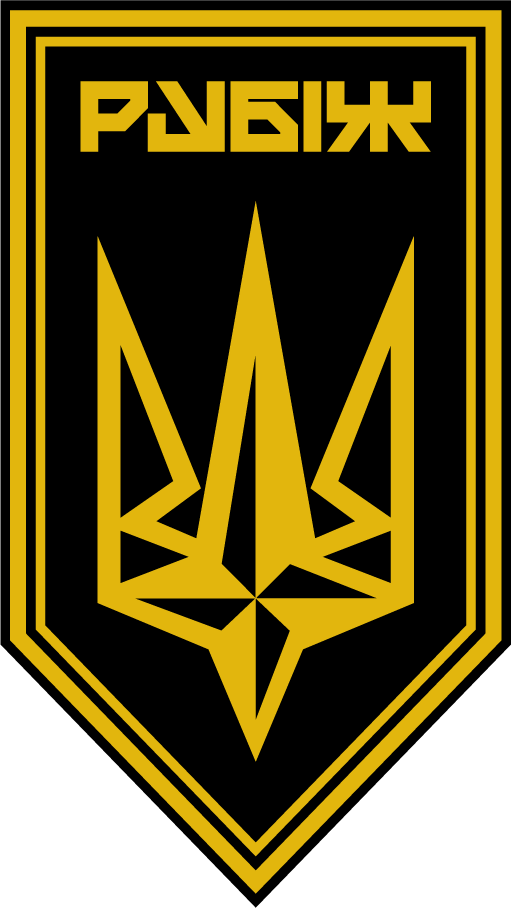
The current emblem features a black shield outlined in gold, with a stylised golden Ukrainian Tryzub in the centre. The name РУБІЖ appears across the upper section. The colour scheme and geometric design create a distinctive military insignia associated with the brigade’s modern identity. The emblem has undergone changes over time, including a redesign reported in December 2025.
The brigade’s motto translates approximately as: We reclaim our country’s rightful borders. The motto reflects the formation’s emphasis on Ukrainian territorial sovereignty.
Training, Recruitment and Military Culture

Rubizh’s organisational identity has long been connected to professional training and rapid-response capabilities. When established in 2015, the brigade was intended to represent a newer generation of National Guard units, drawing upon NATO-inspired practices and lessons learned from Ukraine’s early military confrontations with Russia.
Its present recruitment materials emphasise three priorities:
- Humanity: valuing the lives and well-being of service members.
- Growth: providing professional development and career opportunities.
- Training: building military competence through structured preparation and battlefield experience.
The brigade’s own messaging stresses the importance of experienced commanders, modern training and recognising the individual strengths of recruits.
Drones and Modern Warfare
As with many contemporary Ukrainian formations, drones have become increasingly important to Rubizh. The brigade uses unmanned systems for reconnaissance and other battlefield functions, while engineering and electronic warfare capabilities support wider military operations.
In April 2025, RBC-Ukraine published reporting about a young female drone operator serving with the brigade, offering a perspective on the increasing participation of women in technical military roles. Ukraine’s Ministry of Internal Affairs has also reported on the brigade’s engineering and unmanned-systems personnel.

The Brigade in 2026
By October 2026, Rubizh had accumulated more than a decade of military history.
Its development can be divided into three broad periods: professionalisation during the war in eastern Ukraine before 2022, involvement in the full-scale invasion and major frontline battles, and its integration into a larger corps-based command system from 2025.
The brigade’s experience demonstrates how the National Guard has evolved from a force with substantial domestic-security responsibilities into an important component of Ukraine’s military defence.
In August 2026, several streets in Kyiv Oblast were named in honour of the Rubizh Brigade, recognising its role in defending the region and its subsequent combat service.
This public recognition illustrates the place that the brigade has acquired in Ukraine’s military history
Official Websites and Further Reading
| Source | Website |
|---|---|
| Rubizh Brigade | Official English website |
| Official military recruitment profile | Brigade organisation and leadership |
| National Guard of Ukraine | National Guard website |
| Ukrainian Ministry of Internal Affairs | Government announcements |
| MilitaryLand | Independent unit reference |
| Office of the President of Ukraine | Official report on Rubizh, November 2025 |